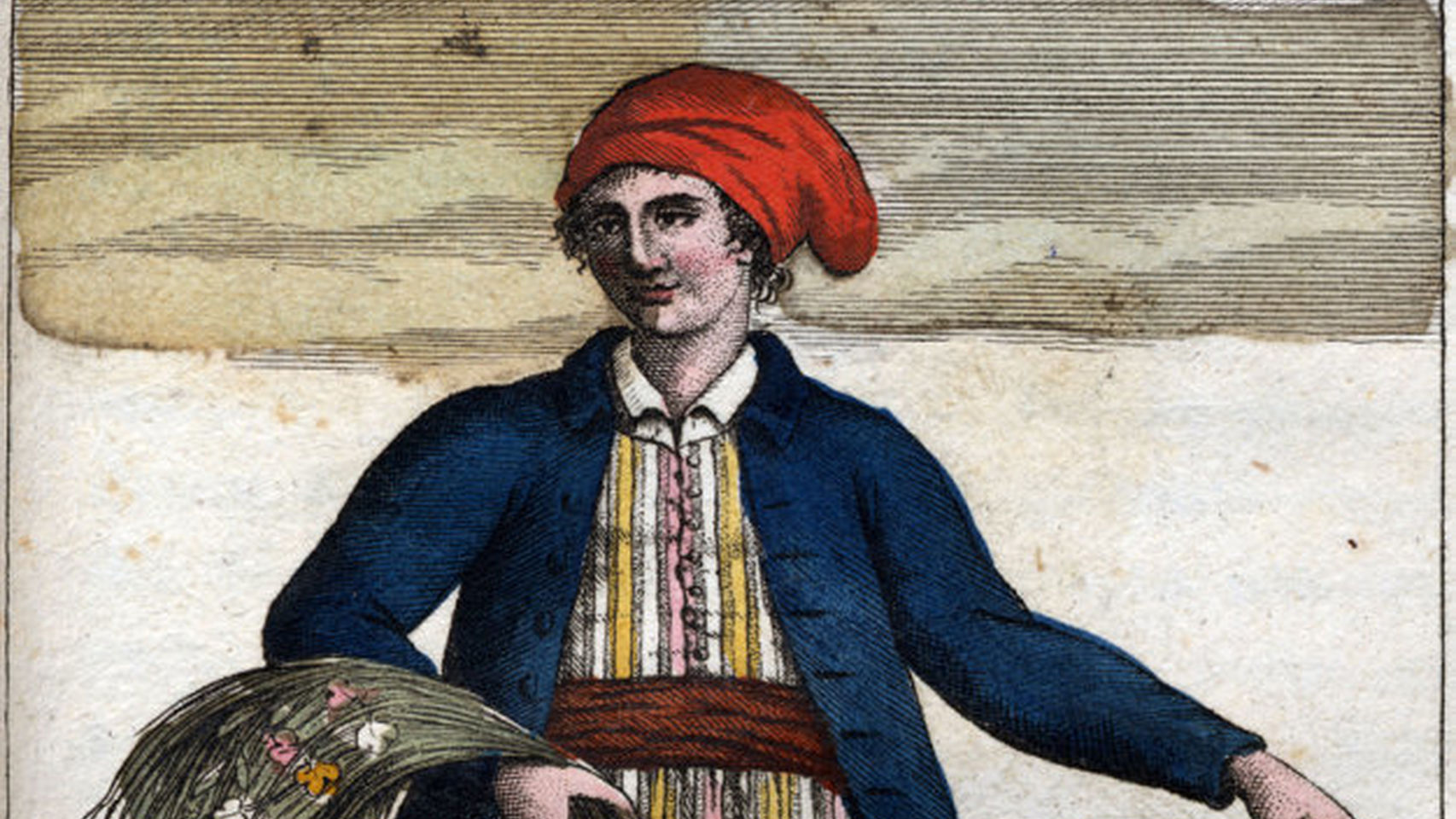
The Woman Who Carried the Vine: Jeanne Baret and the Discovery of Bougainvillea
There is a plant that grows on every sun-warmed wall from Menton to Marrakesh, from the Algarve to Antigua, trailing its paper-bright bracts in shades of magenta, coral, and violet — so ubiquitous now that it is easy to forget it was once utterly unknown to Europe. Someone had to find it. Someone had to kneel in foreign soil, cut its stem, press its flowers, and carry it home across an ocean. That someone, by most accounts, was a young French woman who was not supposed to be there at all.
An Herb Woman from the Loire
Jeanne Baret was born on 27 July 1740 in La Comelle, a small village in Burgundy, to a family of agricultural labourers. The world she was born into offered women of her class a narrow corridor of possibility, and yet from her earliest years she moved through the natural world with a fluency that formal education rarely produces. She became what the French called a herboriste — an herb woman — gathering and selling medicinal plants to the apothecaries and middlemen of the pre-modern medical trade. Her knowledge was rooted not in Latin taxonomy but in something older: the peasant tradition of understanding what grows, and why, and what it does to the body.
It was precisely this knowledge that drew her to the attention of Philibert Commerson, a botanist of some standing who had been appointed as the naturalist aboard a French naval expedition departing in 1766. The expedition was commanded by Louis Antoine de Bougainville, a decorated officer tasked with leading France’s first circumnavigation of the globe. Commerson and Baret were lovers. He needed her. The French Navy, however, did not permit women aboard its vessels under any circumstances.
Jean, Valet and Servant
The solution they devised was as audacious as it was precarious. On the evening before the expedition’s departure, a young man named Jean turned up at the quayside. He was slight, quiet, and wore his hat pulled low. He presented himself as a stranger seeking work as Commerson’s valet. Commerson, playing his part, hired him without apparent recognition. Jeanne Baret had bound her breasts with linen, cropped her identity, and stepped into the most consequential disguise in the history of botany.
She and Commerson were assigned to the Étoile, the expedition’s storeship. Because Commerson had brought an extraordinary quantity of scientific equipment — crates of instruments, jars, drying papers, pressing boards — the ship’s captain surrendered his own large cabin to accommodate him. This was an unintended gift. The relative privacy of that cabin was, in all likelihood, the only reason Baret’s disguise survived as long as it did.
The fleet sailed on 15 November 1766. What followed was one of the most gruelling and magnificent voyages of the eighteenth century, and Jeanne Baret was in the middle of it, hauling specimen cases and plant presses across terrain that defeated far more celebrated men.
Rio de Janeiro, July 1767
By the time the Étoile reached Rio de Janeiro in 1767, Commerson’s health had deteriorated significantly. A persistent leg ailment kept him largely confined, reducing his capacity for fieldwork at the very moment the expedition had arrived somewhere botanically extraordinary. Brazil, even as glimpsed from the edges of a colonial port, was overwhelming in its abundance.
It was here, in the heat and humidity of a South American July, that a climbing vine was collected — a plant with small, almost inconspicuous flowers surrounded by vivid papery bracts in shades that Europeans had no frame of reference for. The specimens were attributed, as was standard practice, to the expedition’s appointed naturalist: Commerson. But given that Commerson was largely immobile during this period, the historical weight of evidence points strongly toward Baret as the one who actually went into the field, gathered the cuttings, and prepared the specimens.
Biographer Glynis Ridley, whose meticulous account of Baret’s life draws on the expedition’s multiple journals, argues that Baret almost certainly collected the first specimen of what would become one of the world’s most beloved ornamental plants. It is a claim that must be stated with care — no field notebook survives in Baret’s hand, no letter of her own testimony. What we have is the circumstantial record of a man too ill to work, and an assistant who demonstrably did everything else.
The formal naming came later, and by other hands. Commerson gave the genus a name in his notes — Bougainvillea, in honour of the expedition’s commander — but it was the French botanist Antoine Laurent de Jussieu who formally published the genus in his Genera Plantarum in 1789, nearly two decades after the specimens were collected, and long after Commerson himself had died. The spelling wandered through the intervening years — Buginvillæa, Bougainvillea, various approximations — before being definitively fixed as Bougainvillea in the Index Kewensis in the 1930s. By then, the question of who had actually knelt in the Brazilian soil and cut the stem was one that almost no one was asking.
The Unravelling
The disguise held for a remarkable length of time, but the world is not infinitely forgiving of secrets kept aboard a crowded ship. Accounts of how Baret’s identity was discovered differ significantly, and the differences matter. The version most widely repeated — because it was written by Bougainville himself — describes a scene in Tahiti, in which the island’s inhabitants recognised her as a woman and threatened her, forcing a confession. It is a narrative with a certain dramatic tidiness.
But four other firsthand accounts of the expedition, including journals kept by the ship’s surgeon François Vivès and a memoir by the naval officer Pierre Duclos-Guyot, tell a different and uglier story. In these accounts, nothing remarkable happened in Tahiti. The assault on Baret’s identity — literal, physical — occurred later, when the fleet stopped to re-provision in the New Hebrides, now Vanuatu, and members of the crew forcibly stripped her. Bougainville, in his published account, had every reason to offer a version of events that protected both his reputation and that of his crew. The alternative accounts suggest he did exactly that.
What is not in dispute is what happened next. Baret and Commerson were permitted to disembark on the Île de France — present-day Mauritius — where they remained for several years, continuing their botanical work. Commerson died there in 1773, his immense collection of specimens still awaiting formal description. Baret eventually made her way home alone, almost certainly becoming in the process the first woman to have completed a circumnavigation of the globe — though she received no official acknowledgment of this for more than two centuries.
What Grows in Her Absence
In 2012, a species of Solanum — a flowering nightshade — was formally named Solanum baretiae in her honour, a belated act of botanical justice. The French post office issued a stamp. Scholars revisited the expedition journals. Her name began, slowly, to be attached to the story that had always been hers.
But the plant she almost certainly discovered continues to bear the name of the man who commanded the ship — a commander who, to his credit, later wrote of Baret with something approaching admiration, acknowledging her courage and her competence even as he recorded events that suggest his crew had treated her with neither.
Bougainvillea is a genus of thorny, woody vines in the family Nyctaginaceae, native to the coastal regions of South America and now naturalised across the subtropical and tropical world. The showy colour of a bougainvillea display comes not from its flowers — which are small and white, easily overlooked — but from its bracts, the modified leaves that surround them. It is a plant that presents a beautiful fiction to the eye: the colour is not where you think it is. The true flower is hidden, modest, almost irrelevant to the spectacle. There is something in this worth sitting with.
Today, Bougainvillea spectabilis — the species most likely collected in Rio, a vigorous grower suited to USDA zones 9–11 and capable of scaling walls to heights of twelve metres and beyond — flowers on balconies from Nice to Nairobi, on pergolas in Los Angeles and Lisbon, on the crumbling gates of villas that have been standing for a century. Its bracts are so saturated, so impossibly vivid against whitewashed stone, that people stop walking and take photographs, or simply stop walking. Few of those people know Jeanne Baret’s name. Almost none of them know it was probably her hands that first folded those paper flowers into a press, aboard a ship where she was not supposed to exist, carrying a secret as tightly bound as the linen against her chest.
History, like the bougainvillea itself, often places its beauty where it is easiest to see, and hides the thing that made it possible somewhere quieter, somewhere small, somewhere you have to look for.